El Vado
(A flat, shallow and firm spot in the river, where one can cross by
foot, on horseback or in a carriage.)
El Vado was painted at El Museo Cultural by Chrissie Orr with help from
Alfonso Chavez Lujan, Andrea Lujan, Jessica Garrett, and Wendy Garcia.
The project was funded by Horse Power New Mexico, which is coordinating
artists to paint horses all around the state. In June these horses will
be placed outside for the summer and then will be auctioned to the highest
bidder. The monies raised from El Vado will go to the National Dance Foundation.
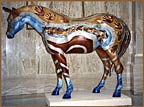
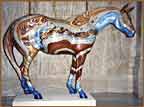
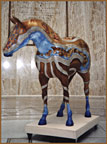
"El Camino Real de Tierra Adentro, the ancient trade route from Mexico City to Santa Fe, was forged by adventurers, explorers and seekers of gold. It was via this route that the horse was reintroduced to North America. Part of the route involved crossing the Rio Grande at El Paso Del Norte where now there is that invisible line, the border, which divides the countries of Mexico and North America. Today this route is still traveled by those seeking a new life. Many succeed. However, many are jumping the fence or wading the river, others are found in the trunks of cars, packed into trucks and get lost crossing the desert. The lure of El Norte endures; thousands are risking all, especially their lives." Chrissie Orr, Armando Espinosa. Tierra Adentro Project.
The horse, in certain mythologies, represents the water god and is regarded as having the gift of causing wells to spring from the ground struck by its hoofs, hence the connection with the Rio Grande. The horse is the symbol of freedom, but where is that freedom for many people of the world.
It was from these thoughts that the concept for El Vado was developed. The newspaper clippings are from the New Mexican, the local newspaper from Santa Fe, and El Diario, the local newspaper from Juarez, Mexico. The symbols in the hands represent water and growth and renewal. One of the handprints is that of the Noble Peace Prize winner Adolfo Perez Esquivel, an activist for human rights, who seeks in his own words, "to be a voice for those who have no voice". He was arrested in his homeland of Argentina, and was once beaten for simply laughing. The bird on the back represents freedom and flight and wind. The text is taken from a speech by Hin-mah-too-yah-lat-kekt, Chief Joseph. The rest is up to the viewer.
El Vado crosses the river in memory of those who have lost their basic human rights to freedom.
Chrissie Orr March 1st 2001
