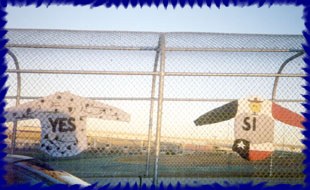
| The Bridge Project is a binational, site specific installation for The Bridge Of The Americas ( also called The Cordova Bridge and El Puente Libre). The project was designed by Chrissie Orr, in collaboration with border artist Carlos Callejo. It was part of the Rio Grande/Rio Bravo Cross Border Celebration and installed in October, 1997. It directly involved the communities of El Paso, Texas, USA, and Ciudad Juarez, Chihuahua,, Estados Unidos De Mexico. The Bridge Of The Americas spans The Rio Grande/Rio Bravo from El Paso to Juarez and is one of the world's busiest border crossings for both vehicles and pedestrians. According to US Customs statistics, there are approximately 25,000 cars and 1600 pedestrians that cross in a twenty-four hour period. Half of the bridge is under the jurisdiction of the US Government and the other half is under the Mexican Government which makes for interesting dynamics. The project was conceived through intensive dialogue and research in the communities and went through considerable changes and modifications during its development. It addresses issues and controversies of the border phenomena and the lives of the borderlanders, whose unique environment is shaped by constant exposure to transnational processes. | 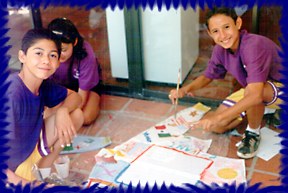 |
 |
The Rio Grande/Rio Bravo is our bloodline, it unites us and should not separate. Pete Duarte |
|
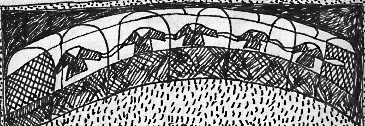
..............with another visit to the border and yet another walk through the pedestrian cage, on The Bridge Of The Americas, there were many thoughts that crossed my mind. The main one was how we could give a voice to the communities, how in a visual manner we could attempt to bring these two diverse communities together and how we could find materials that could be donated or purchased within our limited budget. This walkway is 1512 ft. in length and divided into187 eight foot sections of chain link fence. It was a challenge. I felt strongly that the whole length of the Bridge should be utilized to make the strongest and most dynamic impact. It was important to consider the architecture of the site. On taking all these elements into consideration a concept emerged; the idea of using shirts came to mind...................... |
|
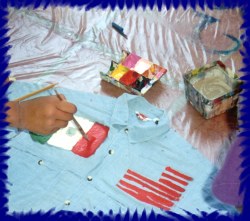 |
.....the shirt has many connotations when put in context with The Bridge and La Frontera. It is normally associated with the business man, the worker who does not get dirty, the one who has an office and a desk. "Wetbacks", "espaldas mojadas" and "camisas mojadas" are derrogatory names for illegal border crossers. The shirts' arms stretched out across the bridge symbolize the coming together of peoples separated by the border's invisible wall. The shape forms that of a cross, and, when placed on the chain link, the image of someone being frisked . The shirts were easy to find; there being many "ropa usada" stores at the border, where clothing is sold by the pound. One shirt, arms outstreched, would fit into one 8 ft. section of the chain link fence. It was important to consider the fact that each shirt would be viewed from two different perspectives. The front would be viewed by pedetrians from inside the walkway, and the back would be viewed from the outside, by seven lanes of traffic coming from Mexico entering the USA. |